
Bowling Green Resident Lookup Sources
Each source used for a Bowling Green resident lookup proves a limited relationship. The Wood County Auditor and Treasurer route connects an identified parcel to the owner shown on the property or tax record. Recorder AVA shows parties to recorded documents, and its electronic index begins in 1980. Voter tools are for checking a specific registration and polling relationship. Court, probate, vital, and library sources answer different questions still. Keep an owner, a voter, a court party, and a historic directory entry separate until dates and other independent details line up.
| Record route | What it can confirm | Bowling Green keeper | Access path |
|---|---|---|---|
| Property or tax account | Owner-of-record link to an identified parcel | Wood County Auditor or Treasurer | Auditor property route; name, address, or parcel tax search |
| Recorded documents | Party role, document type, date, and legal summary | Wood County Recorder | AVA public index and historic books |
| Registration | A specific voter or polling-place relationship | Wood County Board of Elections | VoterView or Board contact |
| Case or estate | Named case, estate, guardianship, or marriage record context | Municipal Court, Clerk, or Probate | Official portal, counter, or records request |
| Historic life-event lead | Published death, cemetery, yearbook, or directory context | WCDPL, WCOGS, and BGSU | Collection, catalog, or staff-assisted research |
Begin with the record that matches the question. An address and owner question starts in property records. A named recorded-document question starts in AVA. A civic registration question belongs with the Board of Elections. For a historical person, a dated directory, newspaper, probate file, cemetery result, or yearbook can supply the needed time context. A Bowling Green resident lookup becomes stronger when it compares two distinct custodians rather than treating one matching name as a conclusion.
Bowling Green Court Lookup Fields
The Bowling Green Municipal Court GovRec search separates civil and criminal routes. Criminal name searching uses first and last name, with direct citation, case-number, court-date, and filed-date routes also configured. Civil searching offers party first and last name, business name, case number, court date, and file date. The display can supply a case or citation number, party name, dates, category, status, and docket context. A docket result identifies a court matter. It does not establish a current address or explain a person’s life outside the case record.
The Common Pleas Clerk directs users to CourtView eServices, but its search entry is protected by CAPTCHA and pre-1990 records may not be online. When the online route does not answer a defined question, use the Clerk counter or request the precise public record. Record the court, case number, date, and jurisdiction with every result. Those details help rule out the same-name problem that can derail an otherwise careful resident lookup.
Note: Sealed, juvenile, adoption, mental-health, expunged, and other protected court material does not become available simply because a name appears elsewhere.
Bowling Green Probate Research Desk
For heir and family-history questions, the Wood County Probate search is a focused local route for estates, guardianships, wills, name changes, marriages, and related public matters. The online form accepts a name in “Last Name, First Name” format, a case number, or a file date. Online records before 1994 may be incomplete or absent. An empty result should lead to the Probate counter, not a claim that no court file exists.
The Probate Court’s public area at One Courthouse Square gives weekday access to paper and electronic dockets, a public terminal, a microfilm reader/printer, tables, and staff. Older originals can be held at BGSU CAC or the Rutherford B. Hayes Presidential Center, while Probate can provide microfilm copies. Its published record-request route accepts counter and mail requests, and callers may ask for copies to be prepared. This local access desk is especially useful when a resident lookup turns into a dated estate or historic vital-record question.
The Probate search screen is a reminder that a case result has its own limits.
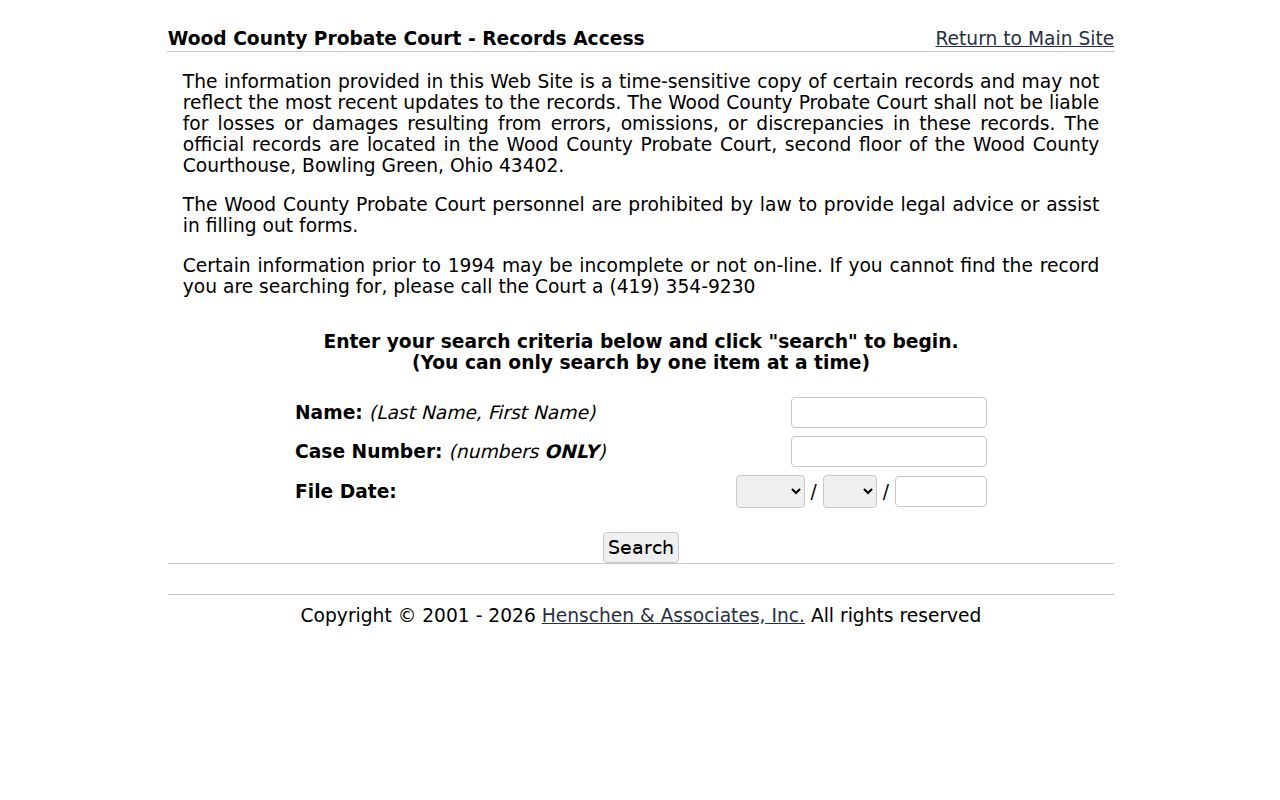
Use the name, case-number, or file-date route to reach a defined record, then request or inspect only the public material that fits the question.
Verifying a Bowling Green Resident
A careful resident lookup anchors a name to a documentable fact, then tests it. A property account is useful only when an address or parcel is already known, because an owner mailing field can differ from the property location. AVA can then verify that the same person appeared in a recorded document role, using a date and legal description to avoid a name-only match. Registration, court, or historic sources should be used for the different relationship each source actually records.
- Write the name exactly as it appears in the first reliable record, including initials or a prior spelling.
- When an address is known, use the Auditor or Treasurer route to retain the parcel ID and legal-description clues, not merely the displayed owner name.
- Search AVA by party, date, document number, parcel, subdivision, or tract. Compare the party role, recorded date, and legal summary with the property record.
- Use VoterView for a specific registration question, or use the proper court or probate file for an independently dated relationship.
- Request a certified record only from its custodian when an official copy is required. Keep the source date and jurisdiction with the result.
- Docket
- A court’s running list of filings, hearings, and case events. It is not a personal profile.
- Index and image
- An index points to a record through names, dates, or identifiers. An image is the document view, when the keeper makes one available.
- Certified copy
- A copy issued by the custodian with its official certification. It is different from a search result or a library index.
Bowling Green Vital Record Paths
Vital records require the right custodian and period. The Wood County Health Department issues Ohio birth certificates from 1908 forward and Wood County death certificates from 1908 forward. Its counter, mail, and online-order channels are different ways to request a certificate, not a public name index. For local 1867–1908 birth and death material, Probate keeps a separate historical copy route. Marriage records are also a Probate responsibility, while divorce material follows the Clerk and Common Pleas file route.
At the state level, the Ohio Department of Health Vital Statistics Office is the alternative statewide custodian. Ohio Revised Code 3705.23 governs signed applications and fee-based issuance. The law also protects birth medical and health information and limits access to a decedent’s Social Security number during the first five years. A certificate, a newspaper notice, a cemetery entry, and a probate file are different records, so a Bowling Green resident lookup should name which one supplied each fact.
Bowling Green Custody Records Are Narrow
Current-custody tools answer a public-safety status question, not a general name search. The Sheriff’s Police to Citizen inmate catalog can show current booking or custody information such as a name, charge, date, holding facility, bond, and release context. Home address and date of birth are hidden in the documented display, and a result should be rechecked with the relevant agency when accuracy matters. County jail, Ohio prison, federal custody, and victim-notification systems each cover a different population.
Wood County’s current inmate catalog is shown below as a separate official route.
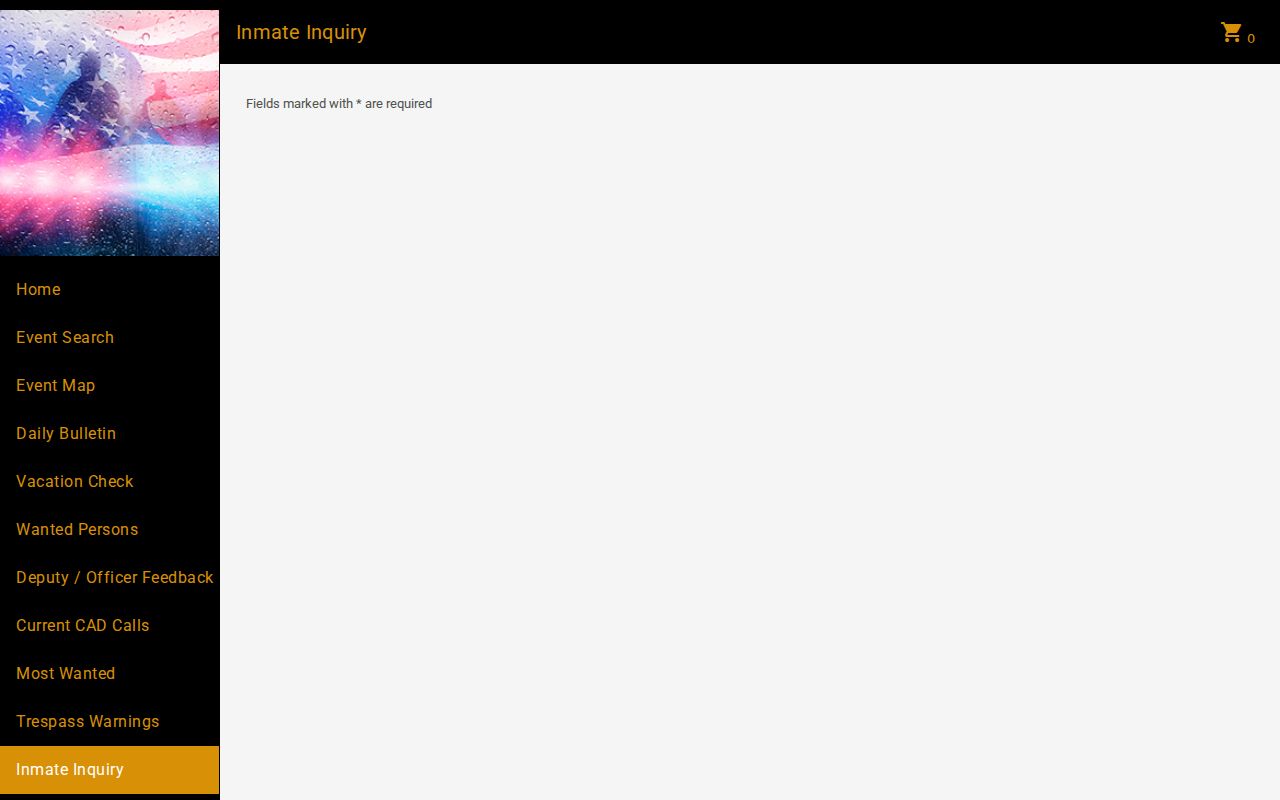
A custody listing should not be treated as a complete history, current personal location, or evidence about another person with a similar name.
No-Match Resident Lookup Paths
A missing online result often points to a coverage boundary or a different keeper. Recheck spelling, initials, date range, and the portal’s era first. AVA’s electronic index begins in 1980, while the Recorder’s historic books include deeds from 1821–1893 and miscellaneous and lease material from 1821–1969. Probate warns that its online material before 1994 can be incomplete. The Common Pleas Clerk flags pre-1990 records as a potential online gap. Those cutoffs describe portals, not the end of the underlying records.
Then use the documented fallback. The Recorder can help with book indexes and copies. Auditor and Treasurer staff can clarify a property account. The Board of Elections handles registration questions and list requests. Probate offers terminal, microfilm, counter, mail, and call-ahead copy paths. WCDPL and BGSU CAC are the local historical routes. Ohio’s Public Records Act, R.C. 149.43 allows a focused request for a named government record, date, address, or project, subject to exemptions and redaction.
Wood County Common Pleas eServices is the court gateway when the case jurisdiction belongs with the Clerk.
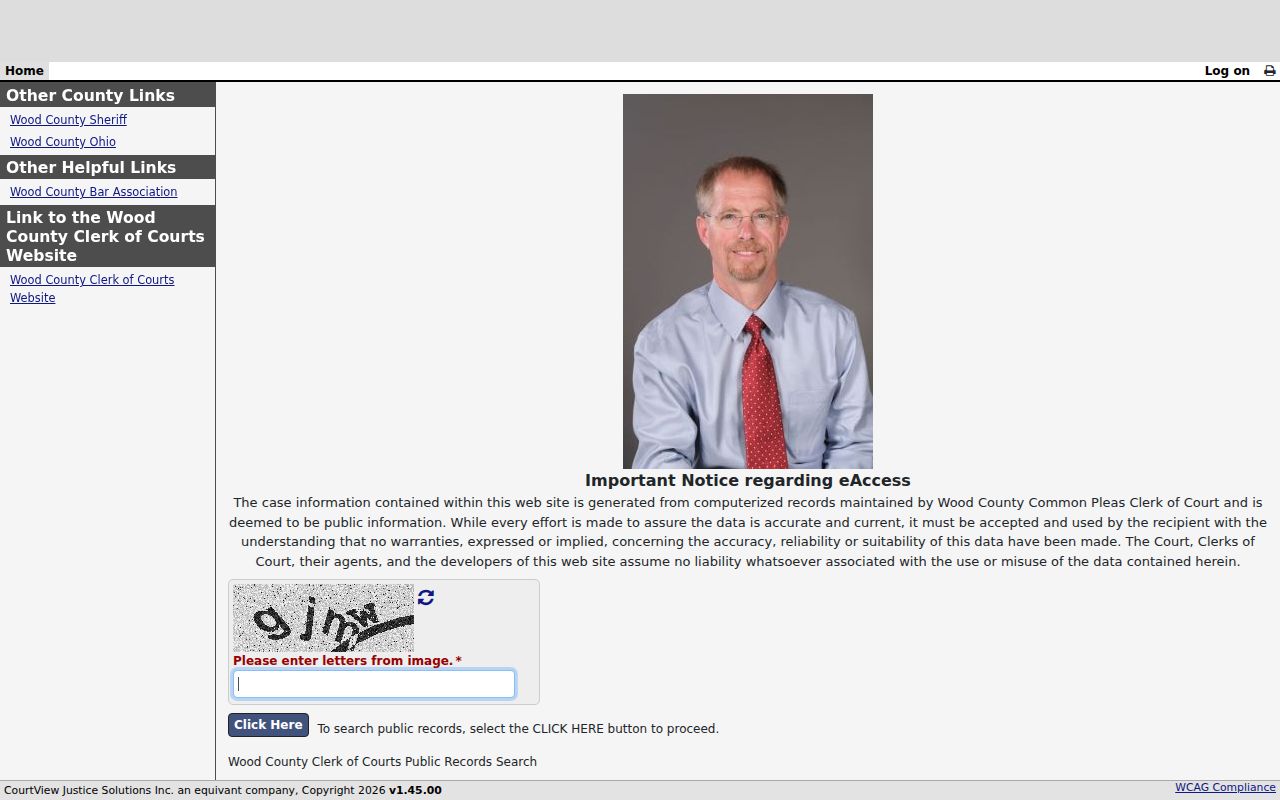
The gateway’s CAPTCHA and older-record limits make a defined courthouse request the appropriate next step when the online route stops short.
Safe at Home and Record Corrections
Ohio public-record access has firm boundaries. Safe at Home, operated by the Secretary of State under R.C. 111.41–111.47, gives qualifying participants a substitute address for voter registration and government correspondence. When its statutory process is followed, it can also protect a later residence from county tax and public real-estate records. A missing or substituted result is not a puzzle to solve. Leave protected information alone and use only the official program’s published contact route.
For an ordinary factual error, contact the keeper of the exact record: Auditor or Treasurer for property display questions, Recorder for an instrument or index issue, Board of Elections for registration, Clerk or Court for a docket filing, and WCHD or ODH for a certificate. R.C. 149.45 also provides an online redaction process for specified protected personal information and qualifying public-service workers. Correcting one record does not automatically revise another custodian’s data.
Lawful Limits for Bowling Green Lookups
A resident lookup is appropriate for personal, lawful research such as family history, reconnecting with an old classmate through published material, an estate question, civic transparency, or checking a record’s source. It does not open motor-vehicle personal information, utility customer information, ballot selections, sealed court material, protected voter data, or the names of every person at an address. Public results can be incomplete, dated, or attached to another person with the same name.
Lawful use. Ohio’s menacing-by-stalking law, R.C. 2903.211, prohibits conduct that causes fear or mental distress. Do not use record results to stalk, harass, threaten, impersonate, or harm anyone.