
Bowling Green Historical Directory Holdings
Several institutions hold pieces of the Bowling Green historical-directory record, and their holdings should remain distinct. The Wood County District Public Library catalog visibly confirms 1897 and 1914 volumes titled City directory of Bowling Green, Ohio: and general information regarding city and county, lodges and societies, parcel post, etc. The catalog identifies City Directory Co. as publisher. It does not establish a complete annual run, a full publisher sequence, or a reverse-directory shelf.
| Collection | Verified years | Where held | Access route |
|---|---|---|---|
| WCDPL cataloged city directories | 1897 and 1914 | Bowling Green/Wood County Collection | Catalog and counter consultation |
| WCDPL Local History collection | Years not published online | 251 N. Main Street | Local History and Genealogy staff |
| Ohio Genealogical Society Library | 1966, 1967, 1971, 1974, 1980, 1982, 1984, 1989, 1993, 1994, 1995, 1997 | OGS special collection | Repository access rules apply |
| Cleveland Public Library microfilm guide | 1930; 1947 through 1959 | Cleveland Public Library | Microfilm guide and library access |
That separation prevents a common error. A year listed by OGS or on Cleveland microfilm is not proof that WCDPL holds it, and WCDPL's collection page does not publish a full run. Ask for the exact year, title, and format before making a trip or drawing a conclusion from a gap.
The catalog display is the source view represented below. It is a useful starting point for a Bowling Green volume request because it identifies two confirmed publications without pretending that unlisted years are absent.
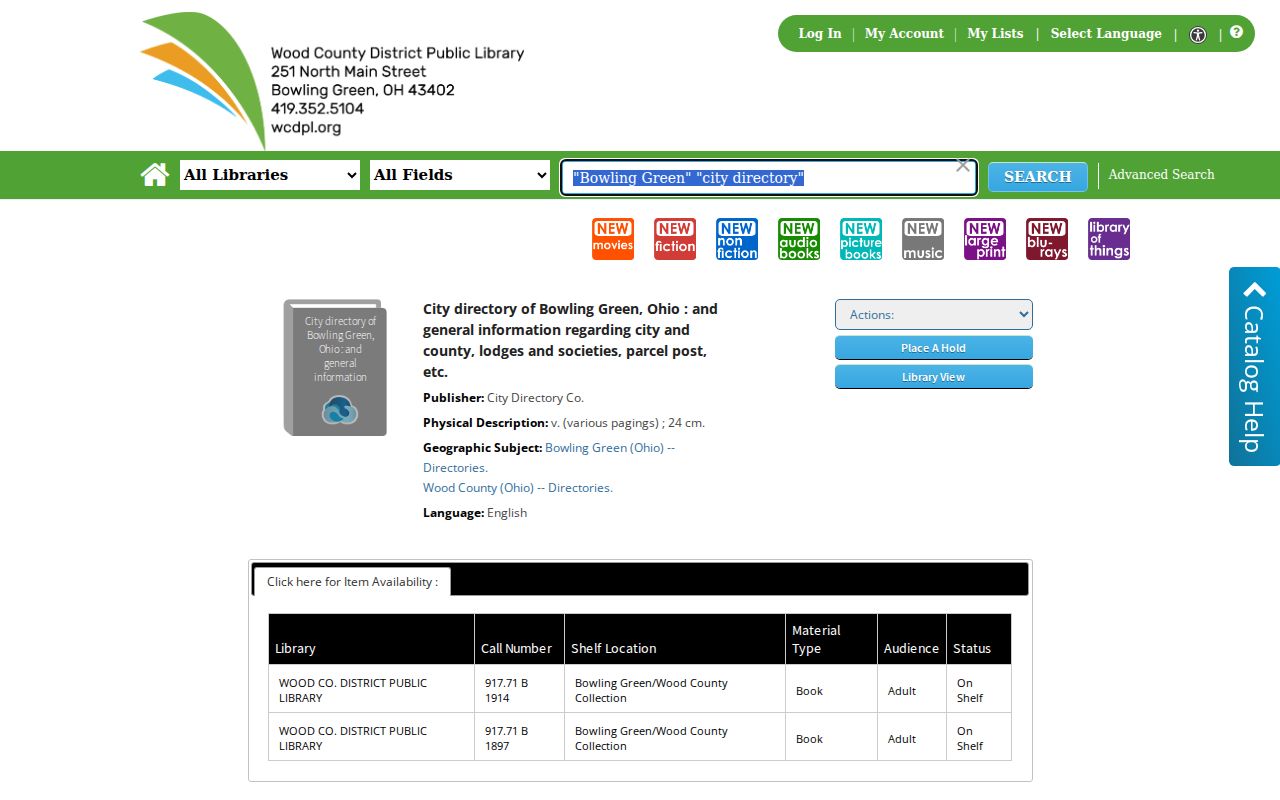
Use the catalog result to give reference staff a precise title and year, then inspect the physical or permitted digital volume for the information a particular listing actually contains.
Bowling Green Local Directory Desk
WCDPL Local History and Genealogy is the local doorway for historical directories, Bowling Green phone books, high-school yearbooks, family histories, military rosters, Wood County census material, research guides, and Ohio-county material. The Bowling Green branch is at 251 N. Main Street and lists public hours of Sunday 1 to 5, Monday through Thursday 9 to 8:30, Friday 9 to 6, and Saturday 9 to 5. Its main telephone number is 419-352-5104.
The library also provides several research channels with different conditions: Ancestry Library Edition is for in-library use, FamilySearch requires a free account with added affiliate-library access in the building, and HeritageQuest is available remotely with a library card. Its Sanborn resource and Ohio Memory material can support a dated address question. The historical archive room may be nonpublic, and staff retrieval may be necessary. Ask rather than assume open shelves.
Note: A collection page confirming directory and phone-book holdings does not verify the contents, sequence, or street-order arrangement of every volume.
Reading Bowling Green Directory Pages
A Bowling Green directory entry must be read from the source page, not reconstructed from a generic directory pattern. No readable digitized local sample entry or local abbreviation key was available during the research. That means the cataloged 1897 and 1914 volumes establish holdings, but they do not verify whether a particular page prints a family relationship, a work role, an address form, a status marker, or an ownership notation. Inspect the volume's headings and key before treating any mark as evidence.
| Name form | Record initials, spelling, and order exactly as printed. |
|---|---|
| Address text | Transcribe the printed location only after viewing the actual entry. |
| Abbreviations | Use the key in that volume if one is present; no Bowling Green key was verified online. |
| Street-order section | Confirm that a volume has one before using it for an address question. |
- Criss-cross directory
- A directory arranged by street or address rather than chiefly by name. WCDPL's online collection page does not confirm such a Bowling Green run.
- Householder index
- An index organized around a household heading. Its presence and labels must be checked in the individual volume.
- Abbreviation key
- A page explaining shortened terms or symbols used in a particular publication. Photograph or transcribe it with the listing when permitted.
This is a productive limitation. It keeps a researcher from turning a clue from one publisher or city into a claim about another Bowling Green volume. When a word cannot be read, retain the image reference or page citation and ask the repository for help.
Bowling Green Directory Companions
Directories work best beside publications that answer a different question. WCDPL lists Bowling Green phone books and high-school yearbooks alongside its historical volumes. BGSU University Archives has a digitized Key yearbook collection for 1918 through 2008, except 1933 and 1935, and points researchers to BG News commencement issues for those gaps. The collection is historical publication evidence, not a current contact list.
The yearbook collection appears in the source image below. Match a name, school year, organization reference, or photograph to the publication date, then corroborate it with another dated source when the question concerns the same person or address.
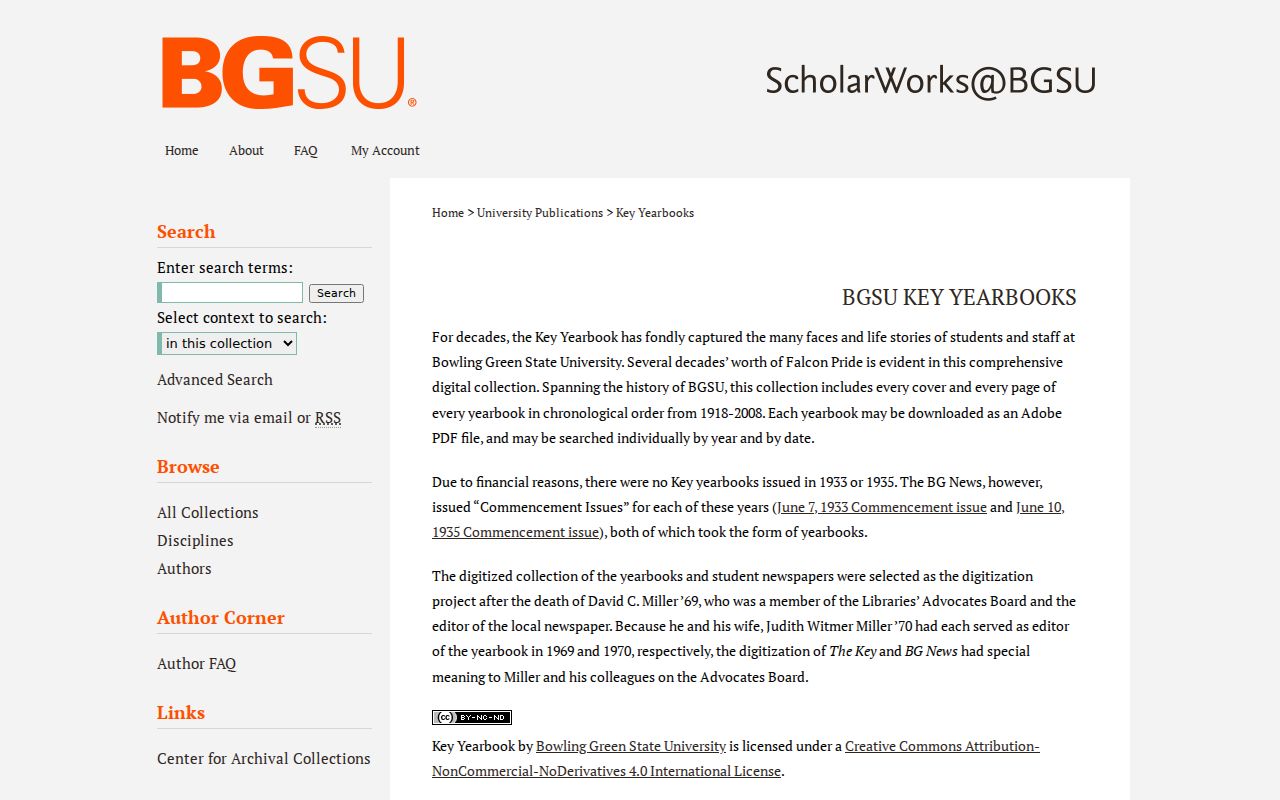
Yearbooks can narrow a time period, while a directory, census, newspaper, or archived record supplies the separate local context. BGSU also holds archival materials with access determined by collection-level finding aids and restrictions.
Bowling Green Directory Dates in Print
A directory year should be paired with the newspaper title that existed at that time. WCDPL's digitized historical newspapers reach back to 1866. The BGSU guide distinguishes the Bowling Green Advocate in 1866, Bowling Green Sentinel in 1867 and early 1868, Wood County Sentinel across two ranges, Sentinel & Gazette from 1889 to 1892, and the Sentinel-Tribune beginning in 1907. A loose search for “Sentinel” can therefore miss the right title.
The WCDPL historical newspaper archive is shown here. Its Local Newspaper Index is partial for the 1960s through 1995 and comprehensive from 1995, while the library's other newspaper services have their own coverage ranges.
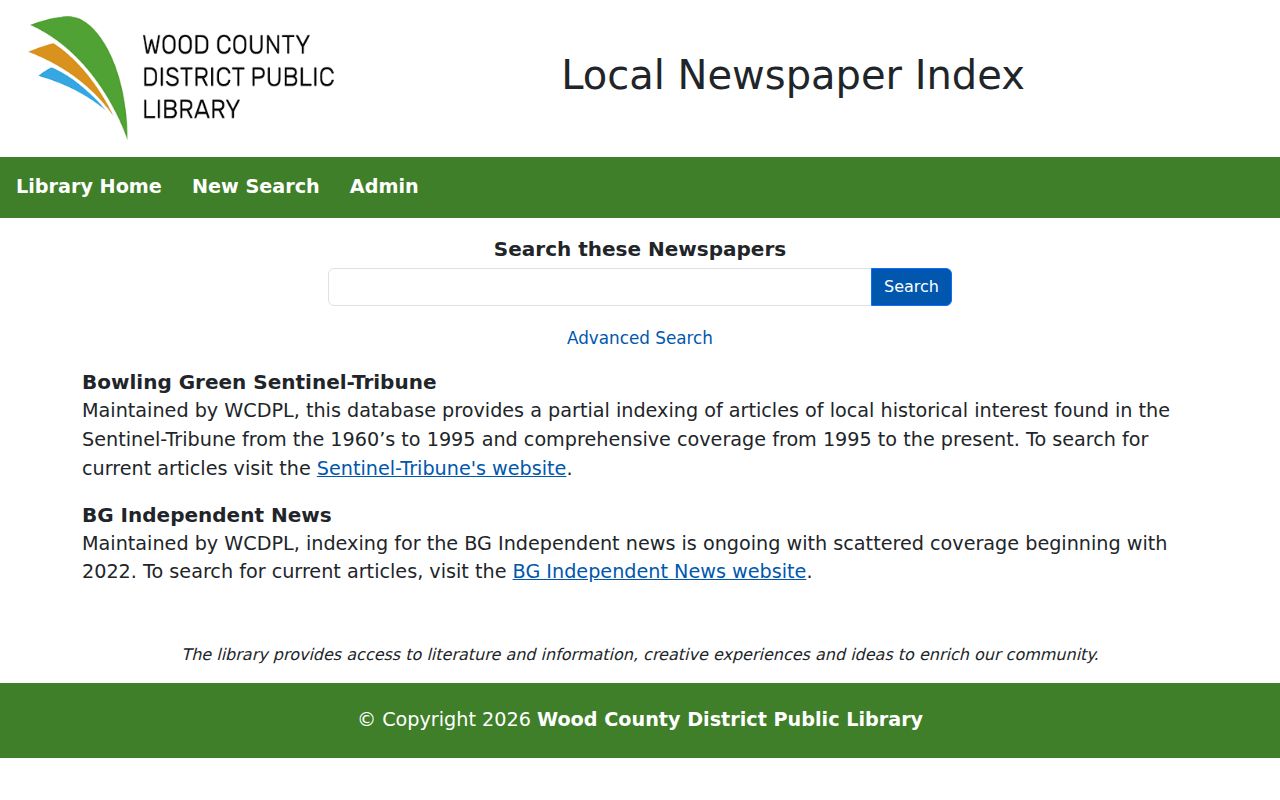
A newspaper can test a move, a property notice, or a death notice suggested by a directory page. It should be cited by the exact title and date, rather than used as proof that every issue is online.
Trace Bowling Green Directory Families
For family history, begin with a confirmed volume rather than a guessed annual sequence. Record the name as printed, preserve the publication year and page, then compare the same name in the next verified edition available from the same or another repository. Federal census schedules are released on a 72-year schedule, and the 1950 census is the latest open federal census at the research date. Census material and the library's subscription tools add a separate household snapshot.
- Request or inspect one confirmed Bowling Green directory year and record its title, page, and name spelling.
- Check the next verified directory year, without assuming that an intervening volume exists.
- Compare a printed address reference with the nearby open census, noting the census enumeration date.
- Use the correct historical newspaper title for the period to look for notices or address context.
- For a later-life endpoint, consult the obituary, cemetery, or probate route that fits the question.
A disappearance from a directory has several possible explanations, including a move, a change in printing practice, a missed volume, or a death. The source sequence matters more than a single absence. For a backward address trail, the Bowling Green previous residents page focuses on deeds, maps, and paired historical sources without repeating these collection holdings.
Bowling Green Directory Archive Layers
Older local context is split among keepers. The BGSU Center for Archival Collections Wood County guide identifies Bowling Green cemetery lot-owner material, cemetery deeds from 1907 through 1921, city council ordinances and resolutions beginning in 1869, council minutes beginning in 1911, Board of Education minutes beginning in 1900, and several later municipal series. CAC welcomes public researchers, recommends contact ahead, and is in Jerome Library's fifth floor.
The archival holdings guide is the source represented below. These are reading-room and request materials, not a substitute for a printed directory, but they can explain a local institution, cemetery lot, municipal decision, or historical address after a source page gives a date to investigate.
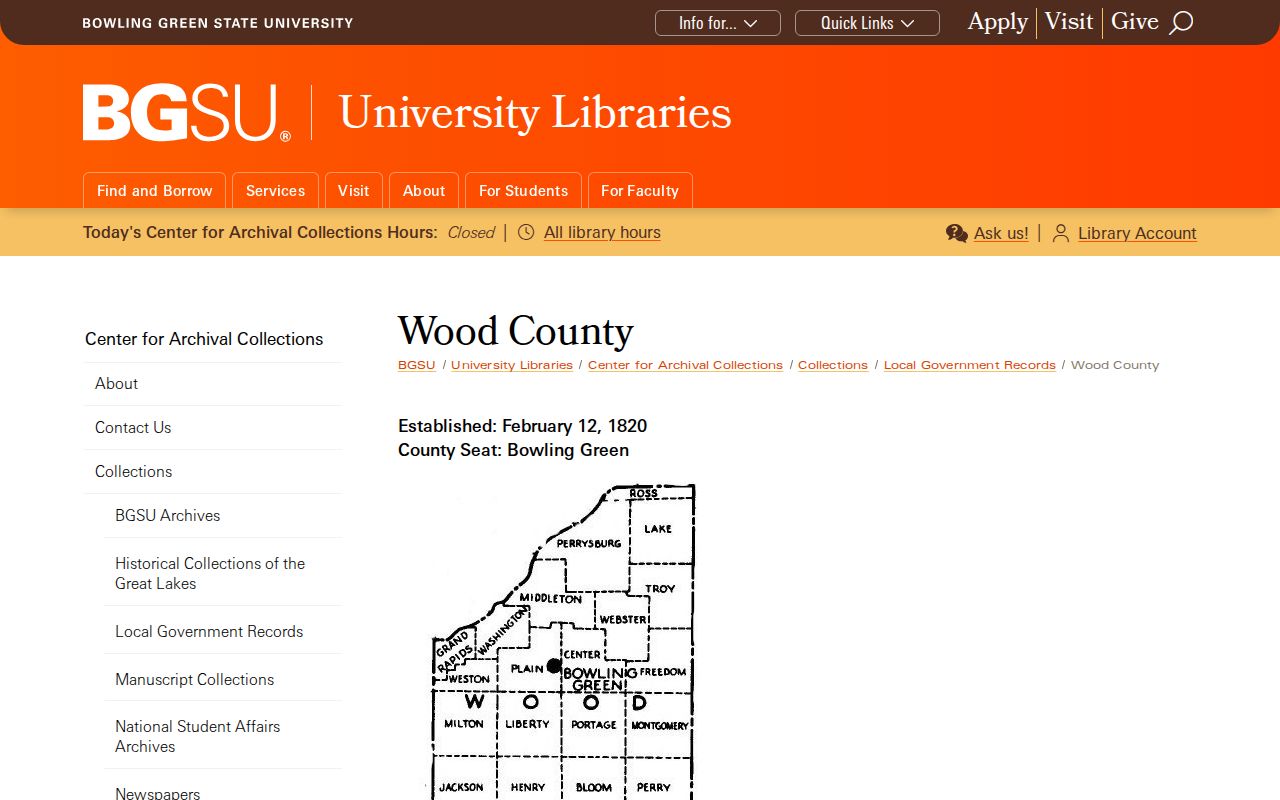
Wood County was established in 1820, while the identified municipal series begin later. There is no authoritative research finding of a countywide fire, flood, or general records-loss event that can be used to explain a missing directory or archive record.
Bowling Green Directory Map Context
The City's historic-property guide links directory and phone-book research with WCDPL, the Auditor and Recorder, Wood County Genealogical Society, Ohio Memory, the Wood County Museum, and BGSU CAC. This local cross-custodian path is valuable for an older property question because a printed volume supplies a dated clue, while other sources can place a building or land description in context. It does not turn a directory line into proof of every person connected with an address.
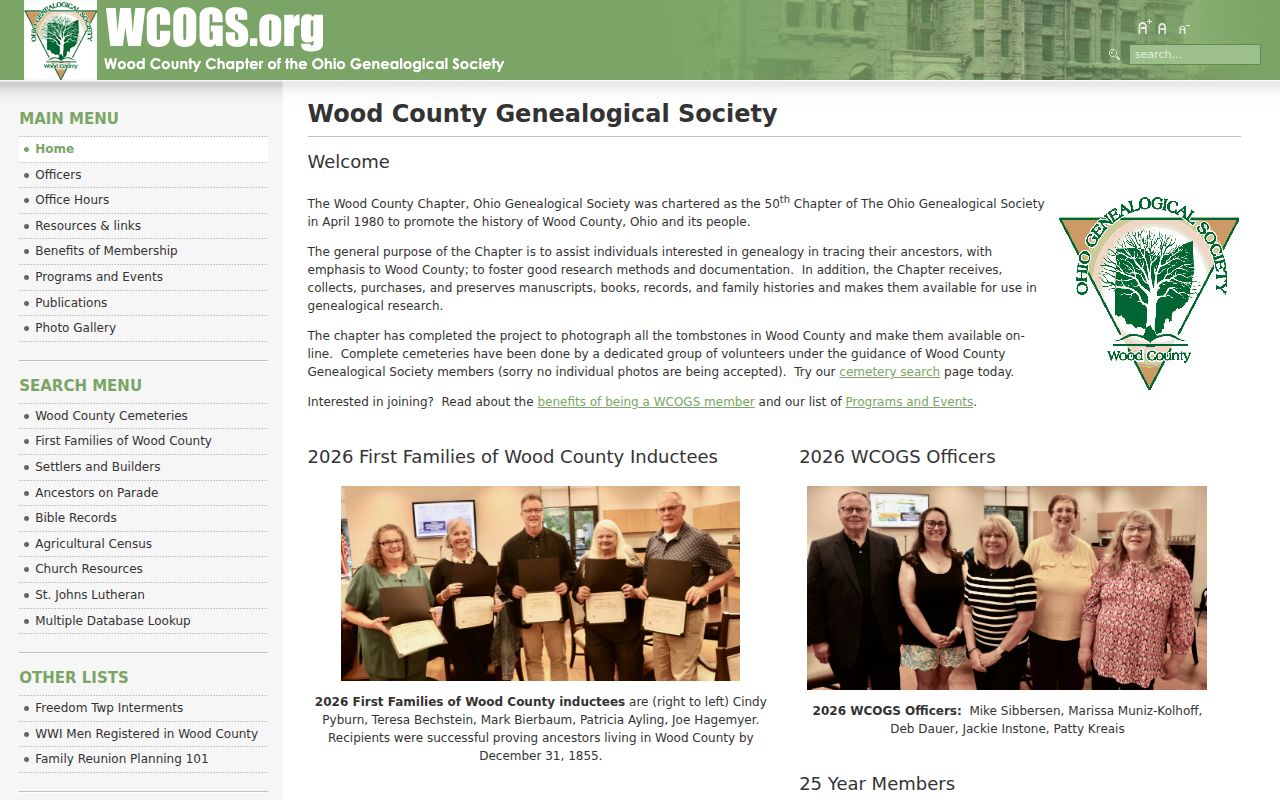
Wood County Genealogical Society's cemetery search reports 55 cemeteries and 99,203 records. Its result display can show a name, spouse reference, cemetery, remarks, and links to a tombstone or cemetery directions. Treat that as a memorial and kinship lead, then verify dates and relationships in the relevant underlying record.
Sanborn maps can add building-footprint and street context. The Library of Congress lists Bowling Green sheets for 1884, 1888, 1893, 1900, 1908, and a public 14-sheet 1915 set. Maps date structures and map use, not a household.
Bowling Green Directory Access Today
Access is improving in specific, limited ways. March 2025 Historic Preservation Commission minutes reported that the WCDPL archive had grown, binder cataloging was under way in the second-floor Reference area, nearly all photographs were online through Ohio Memory, and staff could retrieve materials from an archive room that was not open for browsing. The practical step is to use the catalog and Reference staff before planning an onsite search.
In January 2026, the Commission adopted a 2026 through 2028 plan that identifies possible preservation surveys, historic-resource inventories, register forms, planning materials, workshops, and related studies. That signals potential future documentation. It is not proof that a new searchable name index already exists.
Note: For a known volume, repository, and date, a precise request usually reaches the correct shelf faster than a broad request for all Bowling Green records.