
Finding Bowling Green Residents
Bowling Green serves as the Wood County seat. That makes a county office in town the natural first stop for a resident search. Match each source to the question at hand. An owned property points to the Auditor or Treasurer. A recorded transfer belongs to the Recorder. A registration question goes to the Board of Elections instead. For a past household, a dated directory volume or newspaper page usually beats a present-day property screen.
Property records identify an owner of record and the tax context, not everyone at an address. A Recorder hit marks a party to a document. A voter lookup proves one registration and its polling-place relationship, never a street roster. Those distinctions keep a match honest.
- For an owned parcel, use the Auditor-linked property route or the Treasurer’s name, address, or parcel search and save the Parcel ID.
- Use the Parcel ID, legal description, or owner name in the Recorder index to locate the relevant recorded document.
- For a named civic confirmation, use the official voter lookup and contact the Board of Elections if a likely registration does not appear.
- For a former household, request a verified library directory or phone-book volume and compare it with a newspaper, census, map, or deed record.
- When the needed item is not online, make a focused request for a named government record under Ohio’s public-records law.
Note: Keep the date and the custodian beside every result, because a name that matches without those details can point to the wrong person entirely.
Bowling Green Records Offices
Three offices anchor any Bowling Green residents directory search. The Recorder keeps the instruments that affect land. The Auditor supplies the property-record route, and the Treasurer documents tax-account searching by name, address, or parcel. The Board of Elections handles registration and election administration. Their public tools differ, and their counters still matter when a screen does not reach the period or record you need.
Wood County Recorder
1 Court House Square
Bowling Green, OH 43402
419-354-9140
AVA public document index
Wood County Auditor
One Courthouse Square, Second Floor
Bowling Green, OH 43402
419-354-9150
Wood County Board of Elections
One Courthouse Square
Bowling Green, OH 43402
419-354-9120
Recorder staff can explain book indexes, copy procedures, and how an instrument number or book-and-page citation identifies a document. Auditor and Treasurer staff resolve property-account questions. The Elections office handles no-match registrations and voter-list requests. For a parcel-by-parcel route along a named road, use the Bowling Green street directory. One result is not a whole street.
Parcel Records for Bowling Green Residents
Start with the parcel, not the name. The Auditor's real-estate page starts the property search. The Treasurer confirms searches by name, address, or parcel. An address search works best with the bare house number and street name, dropping the street type if needed. Record the Parcel ID, the property address, the owner-of-record field, and any legal-description clues before moving to land documents.
The official Wood County real-estate information page is the practical starting point. The Beacon search form carries its own filters and result controls. Verify what each field returns before trusting a match.
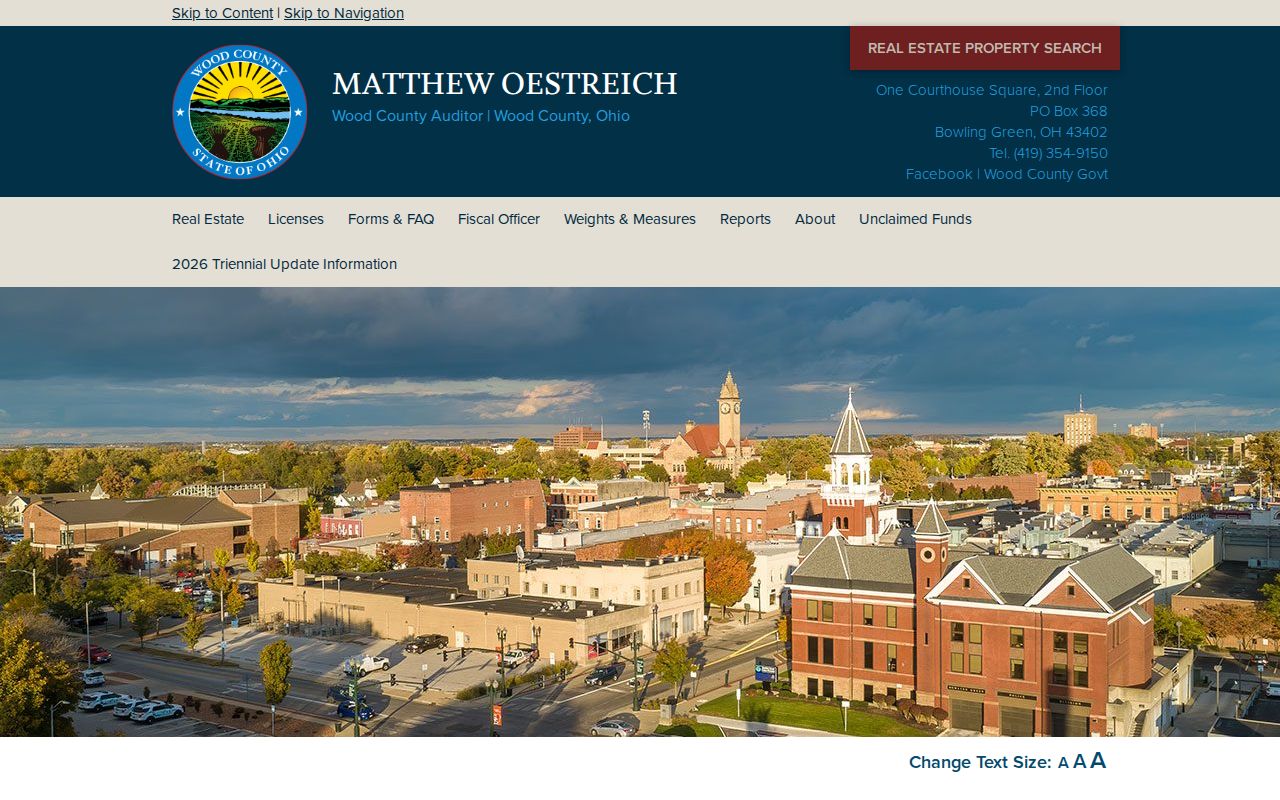
A screen can show two addresses. Mailing contacts sometimes differ from the situs. The legal description, not the tax description printed on a map, is the land identity tying a parcel to Recorder instruments.
- Parcel
- A county identifier for a piece of land or a property-account record.
- Situs address
- The physical street location used to locate a parcel in property and map systems.
- Legal description
- The lot, block, subdivision, or tract description used to identify land in recorded instruments.
- Mailing address
- A tax-contact field that can differ from the situs and does not establish a current physical residence.
Bowling Green Recorder Document Index
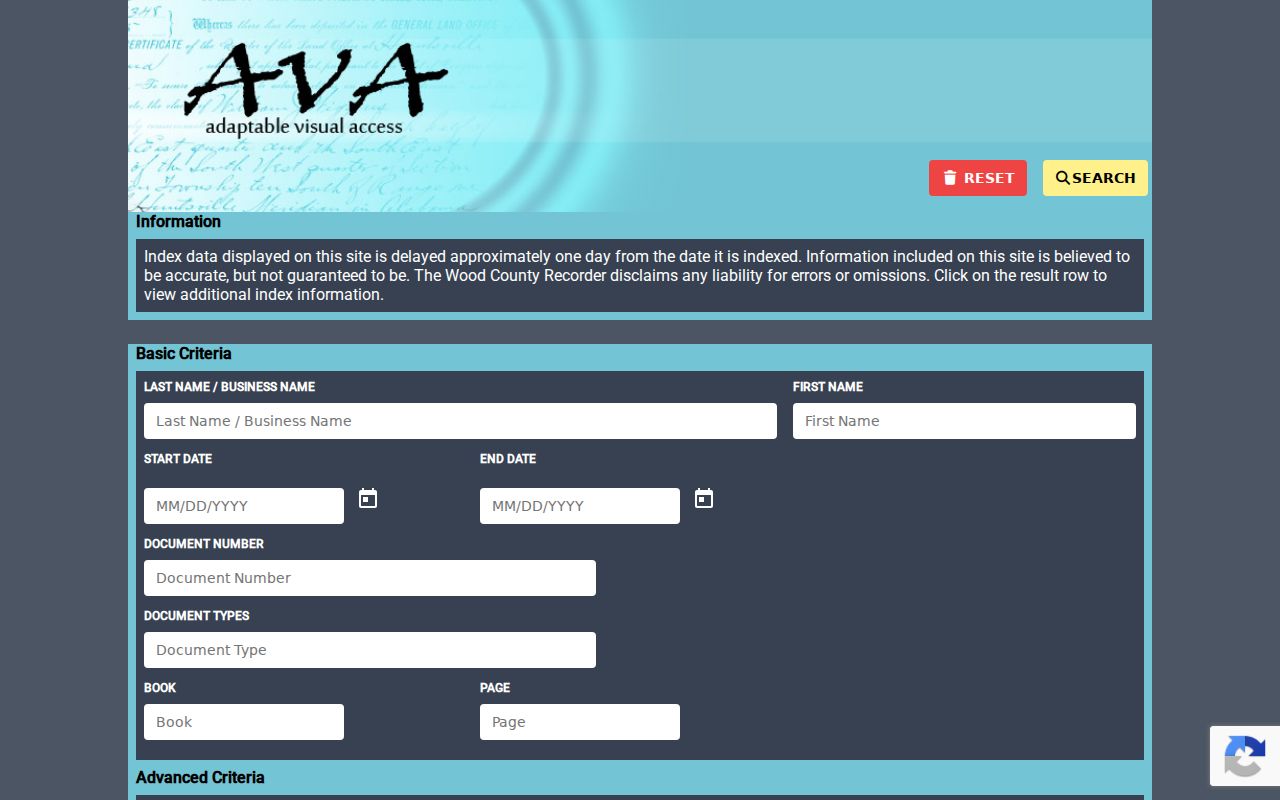
The Wood County Recorder's AVA index is a party-and-document trail. Its electronic index begins in 1980. Displayed data normally lags indexing by about a day. A result can carry document number and document type. It may also show recorded date and time, Party 1, Party 2, and a legal summary. A detail view may add the document date, book and page, parcel, subdivision, and tract. Associated documents can appear there too when configured.
Use the Wood County AVA public index once you hold a parcel or legal-description clue. The compiled address, municipality, reference-number, and quarter-quarter tabs stay off. AVA serves a document role or a parcel trail. It is not a simple street-address residents directory.
Older records follow a different channel. The Deed Index covers 1821 through 1893. Miscellaneous and Lease indexes run from 1821 through 1969. AmeriScan Documents-On-Demand and the Recorder counter preserve the historic-book route, while Laredo serves higher-volume image work by account request.
| AVA field | Use | Local search note |
|---|---|---|
| Last or business name | Party-name route | At least one active criterion is required; wildcard searching is enabled. |
| First name and dates | Narrow a party result | Dates use MM/DD/YYYY and can be paired with a recorded-date range. |
| Document number, book, page | Find a cited instrument | Use the Recorder’s document or historic-book reference. |
| Parcel or subdivision | Follow land identity | Subdivision can be paired with lot and block. |
| Tract fields | Search land description | Section, township, range, and quarter are active; quarter-quarter is disabled. |
Note: A party name in AVA proves a documented role only, not present residence, household membership, or ownership without reading the record itself.
Current Bowling Green Resident Directories
No single official roll lists every Bowling Green resident. Each current source describes one limited relationship. That might be ownership, a voter registration, a recorded document, a court case, a city staff role, or a state credential. Use the source that answers the exact question, then preserve its date and jurisdiction. An old mailing field is not current fact.
| Official record route | Compiled people-search category |
|---|---|
| Names the custodian, record type, date, and access path, so a result can be checked at the source. | May combine records of uneven age and accuracy, so a result needs confirmation from the named government office or library. |
| Separates property ownership, voter registration, court dockets, and historical publications into their actual relationships. | Can blur separate relationships into a profile and cannot replace the underlying date, jurisdiction, or official copy. |
| Official source | Relationship shown | Keeper | Access and limit |
|---|---|---|---|
| Property and tax record | Owner of record, parcel, tax context | Auditor and Treasurer | Property route and counter; not all occupants. |
| Voter lookup | Specific registration and polling relationship | Board of Elections | Official lookup or formal request; protected data remain excluded. |
| Recorder AVA | Party to a recorded instrument | Recorder | Public index from 1980; party role is not residence proof. |
| Municipal staff directory | Public city office role | City of Bowling Green | Department contact route, not a private-person roll. |
| Ohio eLicense | Credential status or affiliation | Participating state boards | City or county shown in a credential record is not a home address. |
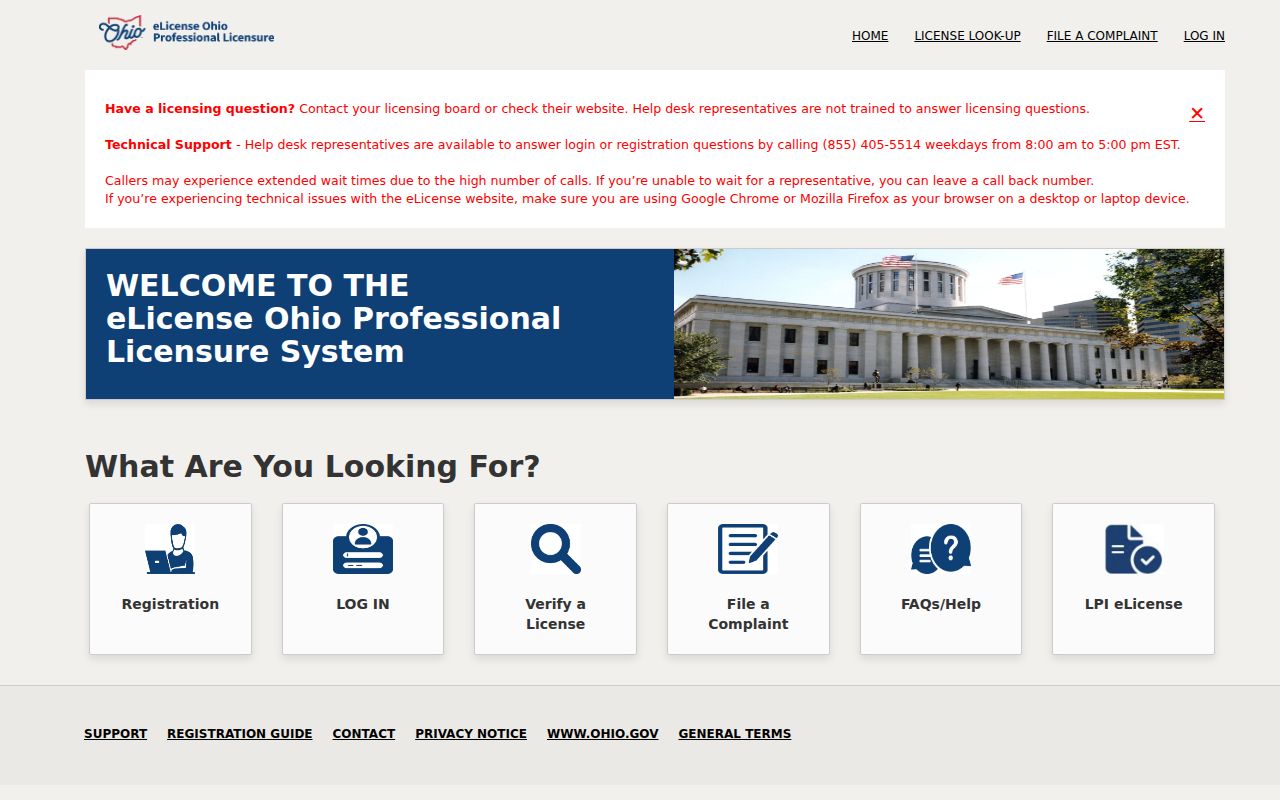
The Ohio eLicense portal offers a separate statewide credential route. It searches an individual by name, alias, board, or license type and number. It also filters by city, state, and county. Results show name, board, number, type, status, and location fields. It is a credential relationship, not an address claim.
Careful verification works best one record at a time. Keep property, court, voter, and historical sources separate in a Bowling Green residents directory search. A name in a resident lookup deserves trust only when two independent dated records agree, not when a single combined profile says so.
Bowling Green Voter Lookup
The Wood County Board of Elections keeps registration current. It offers a county Voter Look-up alongside a polling-place route and a statewide Ohio lookup. Each tool answers a specific question about one person. The county lookup shows whether a named Bowling Green resident is registered. It also shows where that voter falls on the rolls. The polling route places an address at its precinct. A no-match does not end the question. The Board asks anyone whose expected registration fails to appear to contact the office by phone or email. A spelling variation, a recent name or address change, inactive or cancelled status, timing, or a protected record can all hide a real registration.
Ohio law draws a line here. Voter information the public may have is one thing, and information it may not is another. For a defined public request, the Board's list-and-labels channel is the proper route. It has its own listed formats and costs. A street-wide list cannot be pieced together from an individual lookup. Ballot choices stay private. Safe at Home participants and other protected details remain protected. That holds under every residents directory or voter rolls use.
Bowling Green Court and Probate Records
Court records answer a different question than a residents directory. Bowling Green Municipal Court runs its docket access through GovRec. Municipal criminal, traffic, civil, and related cases can be searched by criminal first and last name, citation, case number, court date, or filed date. Civil matters go by party or business name plus case or date routes. A result carries case context, a party, a date, and a docket trail. Same-name hits still need a second independent identifier. That keeps anyone from treating them as the right person.
Wood County Common Pleas uses CourtView eServices for its online side. The counter and copy route covers material that is not online, including records before 1990. Probate opens a public search by name, case number, or file date. The coverage runs across estates, wills, guardianships, name changes, and marriage licenses. Its weekday public area holds paper and electronic docket access, a public terminal, and a microfilm reader and printer for older local material. Sealed files stay sealed. Juvenile, adoption, mental-health, and other protected cases never surface through a name search in any city directory or court index.
Note: A docket records a case relationship and a date, not a current address or a full account of private circumstances.
Bowling Green Vital Record Routes
Every vital record has a named custodian. Locally, the Wood County Health Department issues Ohio birth certificates from 1908 forward and Wood County death certificates from 1908 forward, through counter, mail, and online VitalChek channels. Probate holds the older Wood County material, historic birth and death records from 1867 through 1908, plus local marriage records. When the local path does not reach the event, the Ohio Department of Health Vital Statistics office is the statewide route.
A certificate is not a searchable index. Ohio Revised Code 3705.23 allows issuance on a signed application and fee unless a record has ceased to be public. The same law protects birth medical and health data. A decedent's Social Security number stays restricted for the first five years. For family history, a probate file, cemetery result, obituary, or directory entry can point the way, but none of them replaces the certificate process.
Bowling Green Cemetery Name Records
A name trail in Wood County reaches beyond land and court files. The Wood County Genealogical Society's searchable cemetery collection covers 55 cemeteries and reports 99,203 records. Its search needs a name in Last or Last, First form. Results can show the name, spouse, cemetery, remarks, tombstone links, and directions to the cemetery. The collection is a strong memorial and kinship lead. It is not proof of any present address.
BGSU's Center for Archival Collections adds a Bowling Green cemetery lot-owner index. It also holds cemetery deeds covering 1907 through 1921. Weigh any cemetery result against a dated obituary, estate file, city directory entry, or newspaper item. Draw no family conclusion from one record alone. The record tells a researcher where to ask next. It does not fill in facts the stone and deed never held.
Bowling Green ZIP Labels
A ZIP label validates a mailing address. It does not define a residents directory or a jurisdiction. Bowling Green addresses normally carry 43402 for civic and postal use. Bowling Green State University holds unique ZIP 43403, and its postal service delivers mail bearing that ZIP to campus. Neither label settles city limits, parcel ownership, voting jurisdiction, or a neighborhood boundary.
The USPS address lookup confirms the mailing ZIP. For a jurisdiction question, rely on a parcel map, legal description, city-limit map, or Planning confirmation. A Bowling Green mailing label can extend past the municipal boundary. Later annexation does not automatically redraw postal delivery geography, which matters most near the city edges and for BGSU-related addresses in any ZIP code directory.
Historical Bowling Green Resident Directories
Wood County District Public Library is the local shelf for Bowling Green phone books, city directories, high-school yearbooks, census material, family histories, and historical newspapers. Its catalog lists 1897 and 1914 Bowling Green city-directory volumes. The Ohio Genealogical Society holds selected volumes from 1966 through 1997. Cleveland Public Library keeps separate microfilm for 1930 and for 1947 through 1959. These are distinct holdings, not a promise of one complete annual run.
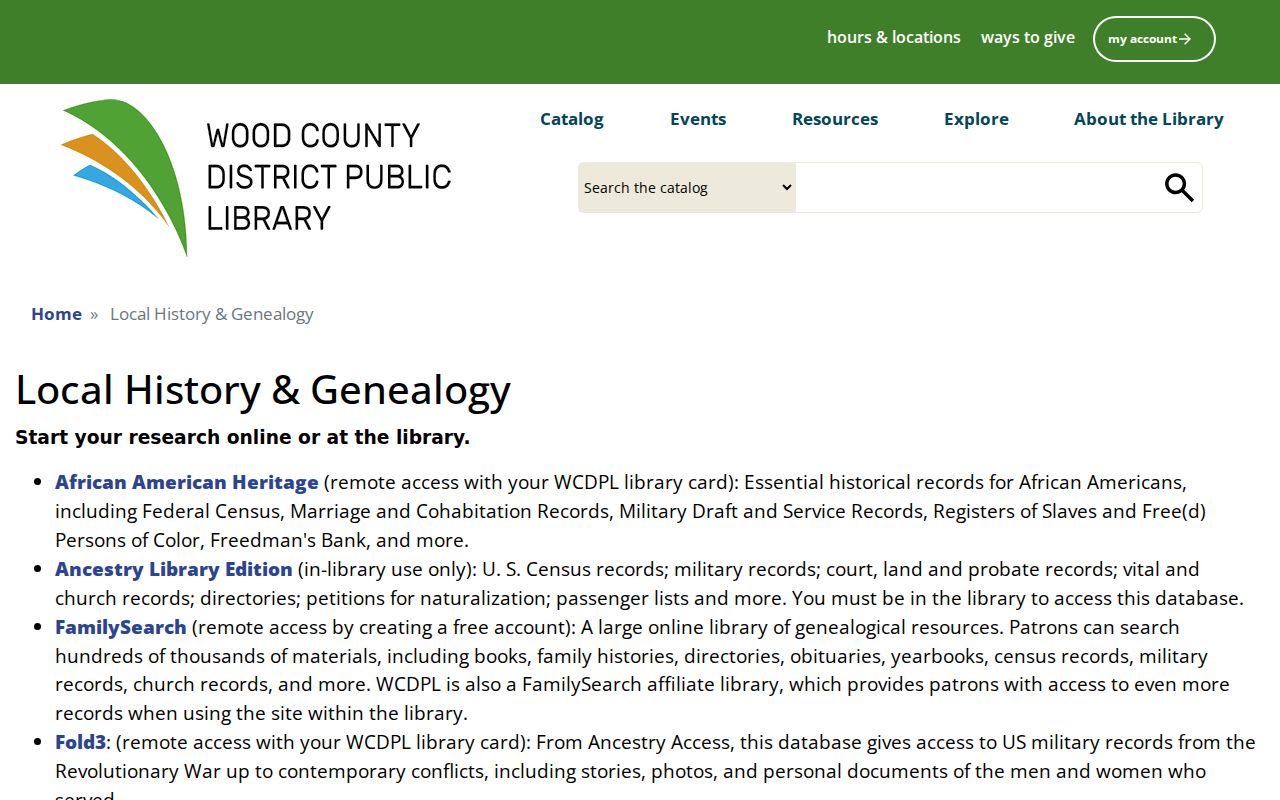
The WCDPL Local History and Genealogy collection carries the local library route. Some historical archive room material sits behind staff retrieval. Ask reference staff for a specific volume or catalog item rather than assuming every past residents source waits on an open shelf.
Every Bowling Green directory entry deserves a look at the original volume. Abbreviations, name spellings, and ownership marks vary from year to year. A transcription alone can mislead. Digitized samples and local abbreviation keys are scarce for this residents directory material. Confirm labels and address notation in the book itself first. For a deeper year-by-year view, the Bowling Green city directory collections carry the fuller detail.
Bowling Green Archives Keep Layers
Bowling Green's paper trail sits in layers, and each custodian holds a different slice. Wood County dates to 1820. BGSU's local-government inventory lists Common Pleas journals from 1820 to 1935, Probate marriage records from 1820 to 1950, tax duplicates from 1827, and Recorder material described as circa 1817 to 1855. Later municipal series include council ordinances and resolutions from 1869, council minutes from 1911, and cemetery deeds spanning 1907 through 1921.
Those modern dates mark online cutoffs, not creation dates. The Recorder's electronic index opens at 1980. Common Pleas cautions that pre-1990 records may sit offline, and Probate notes that records before 1994 can be incomplete online. Older municipal files often rest at BGSU's Center for Archival Collections, while WCDPL and WCOGS hold local directories, newspapers, maps, and family-history tools. That split custody is the real records story for anyone tracing past residents of Bowling Green.
Bowling Green Public Record Limits
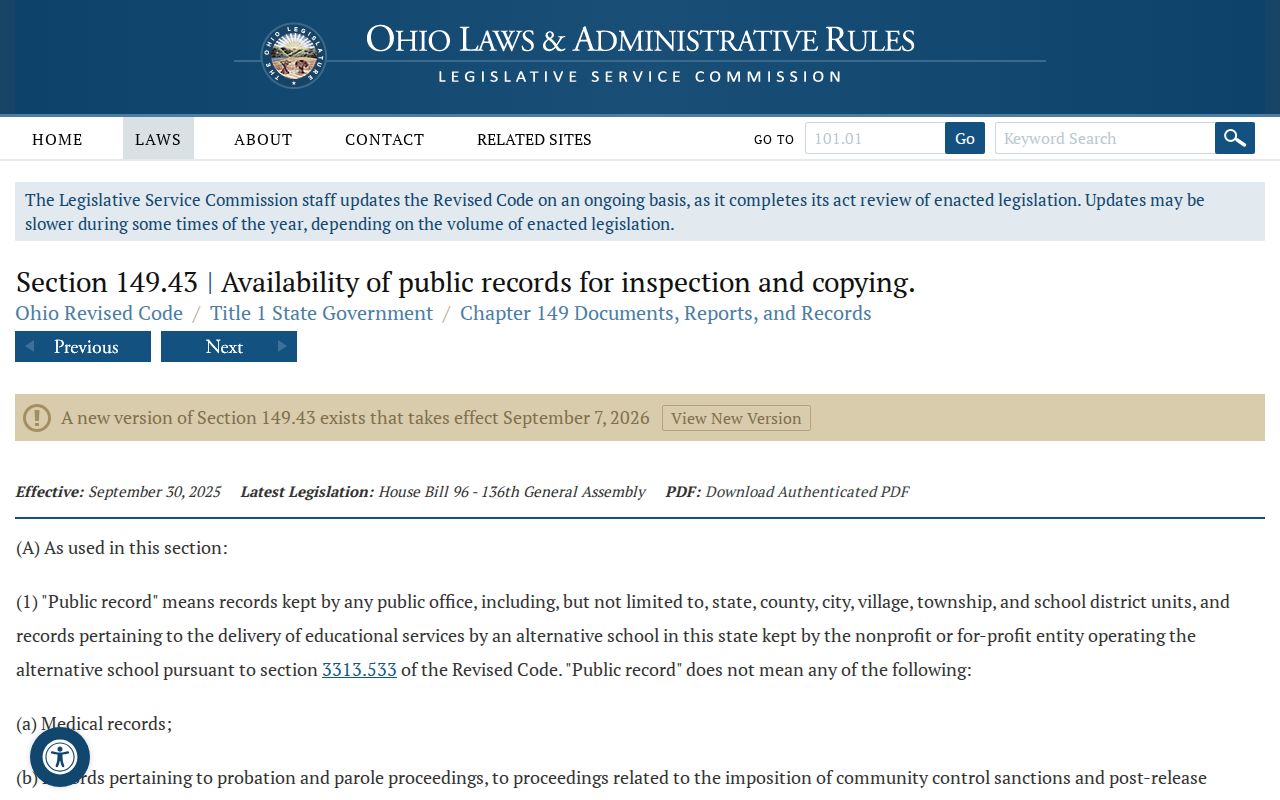
Ohio's Public Records Act, R.C. 149.43, opens public offices to inspection and copies, exemptions aside. When a portal lacks an item, a focused request works best. Name the record, date, address, or project. An office may redact protected details or deny an exempt record with its legal reason. Some material never qualifies for ordinary lookup. Medical records, protected personal information, sealed court files, and juvenile records stay outside a public residents directory search. The same goes for adoption records, confidential investigative files, and Safe at Home data. The official Ohio Public Records Act text defines access around government records. It does not open the door to broad hunts for private household details. A city directory or parcel record serves most legitimate resident lookup needs better.
Ohio's Safe at Home program lets qualifying participants use a substitute address for voter rolls and government mail. Its statutory process also shields certain later-acquired residence details. A missing or substituted result is an endpoint. It is never a reason to chase a protected address through the property rolls.
The Ohio Department of Rehabilitation and Correction offender search is a separate official status tool. It is not a resident list. Any displayed residential county or ZIP can lag behind present circumstances, so treat it as a snapshot rather than a current street directory entry.
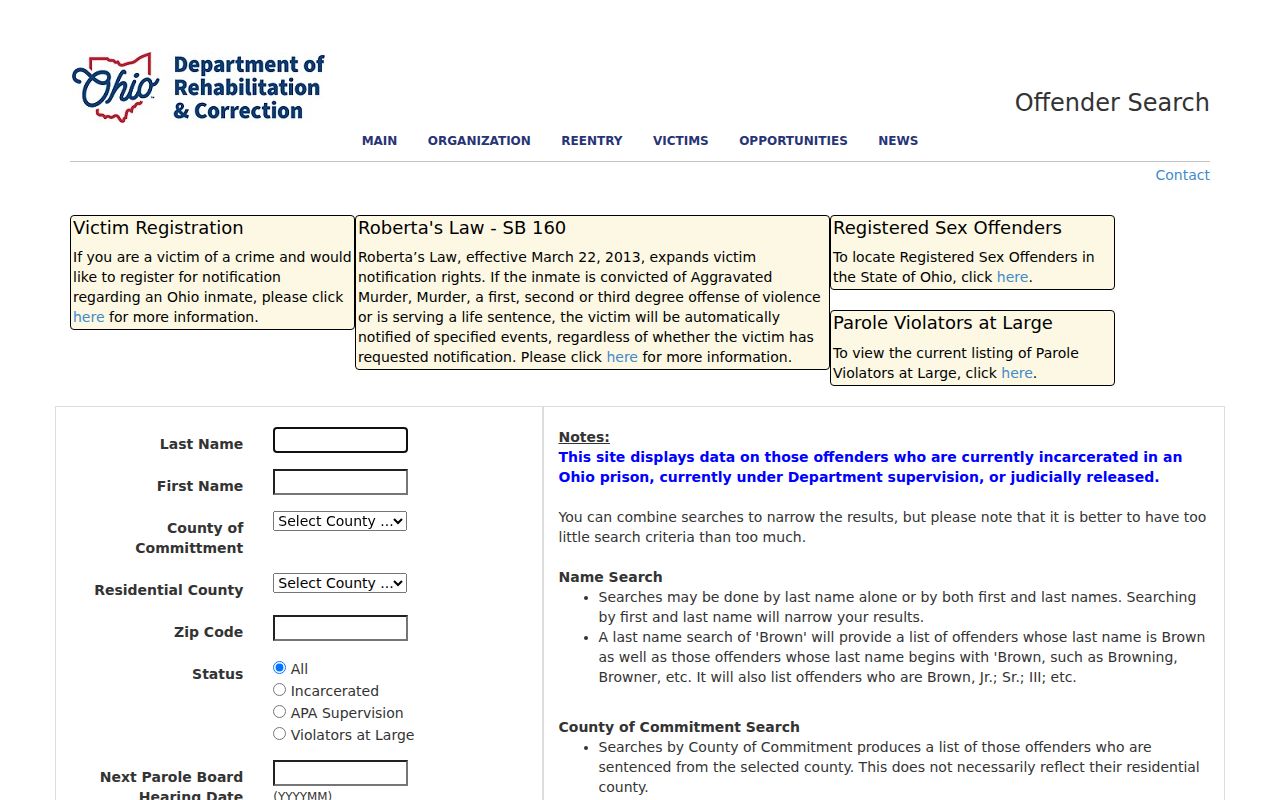
Use that status display only for its stated public-safety purpose. Significant details belong with the responsible agency or court. An older result is never proof of where someone lives now in Bowling Green.